Episodes
Gorilla Whoop Whoop, Episode 0: Why Would Anyone Do This
It seemed like a fun hobby
Every bad decision starts with "that looks fun." Mine was FPV drones.
FPV stands for first-person view. You wear goggles, and you see what the drone sees, live, through a tiny camera on its nose. You aren't watching a drone fly. You are the drone. Ideally a drone that doesn't hit things.
On paper it was right up my alley. It's a hobby made of other hobbies:
- Radio: one link carries your stick commands to the drone, another carries video back to your face. Both are fighting physics, walls, and your neighbor's router.
- Electronics: flight controllers, motor controllers, firmware you compile yourself, settings with names like
dyn_notch_q. - Batteries: tiny lithium packs with a lot of energy, strong opinions, and a short temper.
- Flying: the actual point, allegedly.
It looked like the kind of rabbit hole you fall into on purpose. So I planned to jump in head first.
Then the fire nation attacked
For a while, FPV started looking like my next hobby. Something people did for racing, freestyle, and dramatic videos of mountains. I wanted some of that.
Then Russia launched its full-scale invasion of Ukraine in 2022, and the same kind of small, cheap, hobby-grade drone ended up at the center of a war. Both sides used them to scout, to spot artillery, and to strike. Parts that had been sold for weekend racing became a front-line technology. Jamming the radio links became its own arms race, and each side kept adapting to the other.
This wasn't funny, and I'm not going to make it funny. But it changed how I saw the hobby. The skills behind it, radio links, interference, electronics, batteries, and the flying itself, clearly weren't niche anymore. This tech was going to matter, a lot, for a long time.
I didn't want to be the person who finds out how the future works by reading about it later. I wanted to understand it hands-on, from the radio waves up. The safest, cheapest, most peaceful way to do that turned out to be a 21-gram drone with propeller guards, flown at my own furniture.
That was 2022. Life, as it does, had other plans. I didn't actually start until this year. Four years of research, zero hours of flying. Peak efficiency.
Picking the gear
I did the research. I had three requirements, in order of honesty:
- Affordable. I would be breaking it. This was not a guess.
- Easy. Something that works mostly out of the box, so I'd be learning to fly instead of learning to solder. (Foreshadowing: see Episode 1.)
- Crash resistant. The most important one. See requirement 1.
I looked at a few options. Then I heard the words "gorilla whooping," and the research was over. Tiny whoop, analog video, indoors. That was where I'd start. A tiny whoop has ducts around the props and is light enough that crashes are an inconvenience instead of an event. Analog video keeps it cheap.
The tiebreaker: the Air75 was already one of the drones in the simulator I was using. I could practice on the exact model I'd buy, and it was affordable. Here's what I settled on:
| Gear | What it does | Why I picked it |
|---|---|---|
| BetaFPV Air75 | The drone. 1S battery, about 21 g | Light, ducted props, built to bounce off walls |
| RadioMaster Pocket | The radio controller (ExpressLRS) | Small, affordable, and also works as a simulator controller |
| Eachine EV800D | The goggles (analog video) | Cheap, built-in recorder, and good enough to learn on |
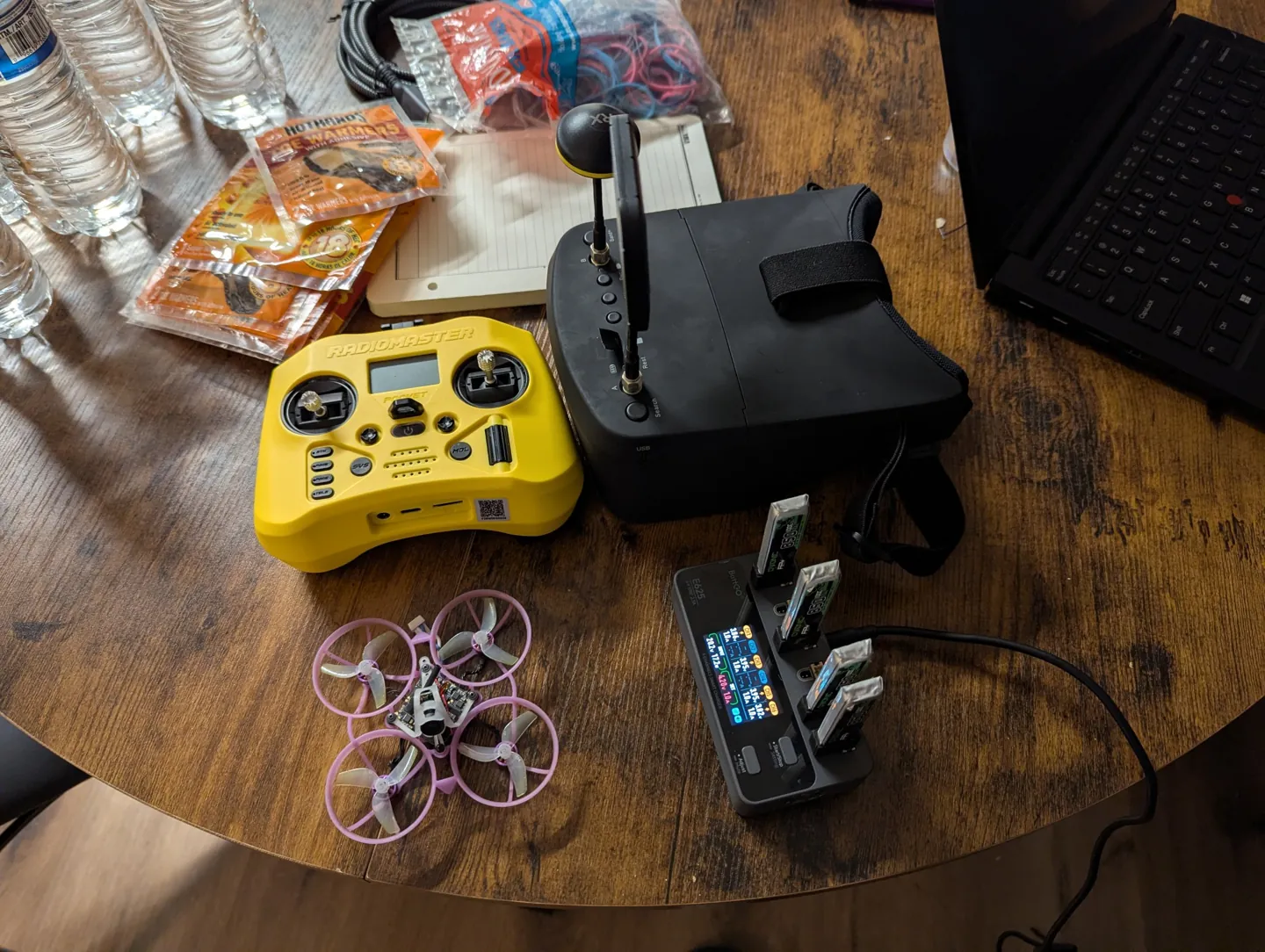
The logic was simple: crash something cheap and small a few hundred times, instead of crashing something expensive and large once.
Fifty hours in the simulator
Everyone in FPV gives the same advice: start in a simulator. Crashes in a simulator cost nothing. Crashes in real life cost props, frames, and, apparently, a blog series.
So before the real drone flew, I put 50 hours into Liftoff: Micro Drones, a simulator built around tiny whoops. Same radio, plugged into the computer. Same sticks. Same bad decisions, minus the repair bill.
Fifty hours taught me a lot:
- Throttle is its own job. Your left thumb holds altitude the whole time. No autopilot does it for you, at least not in acro mode.
- Acro is a different sport. Let go of the sticks, and the drone keeps doing whatever it was doing. Including the bad thing.
- Orientation is everything. When the drone faces you, left is right. Your thumbs eventually stop arguing about it.
- Respawn is a button. This turned out to be the most important feature of the simulator, and the one most missing from reality.
I flew acro from early on, because apparently I like learning things the hard way. There was no single trick I got stuck on for hours. Controlling the drone at all was the trick.
After 50 hours I could fly through gaps, around furniture, and occasionally on purpose. I felt ready.
I was not ready.
The first real flight
The Air75 arrived. I charged a battery, put on the goggles, and armed it with the quiet confidence of a man with 50 simulated hours.
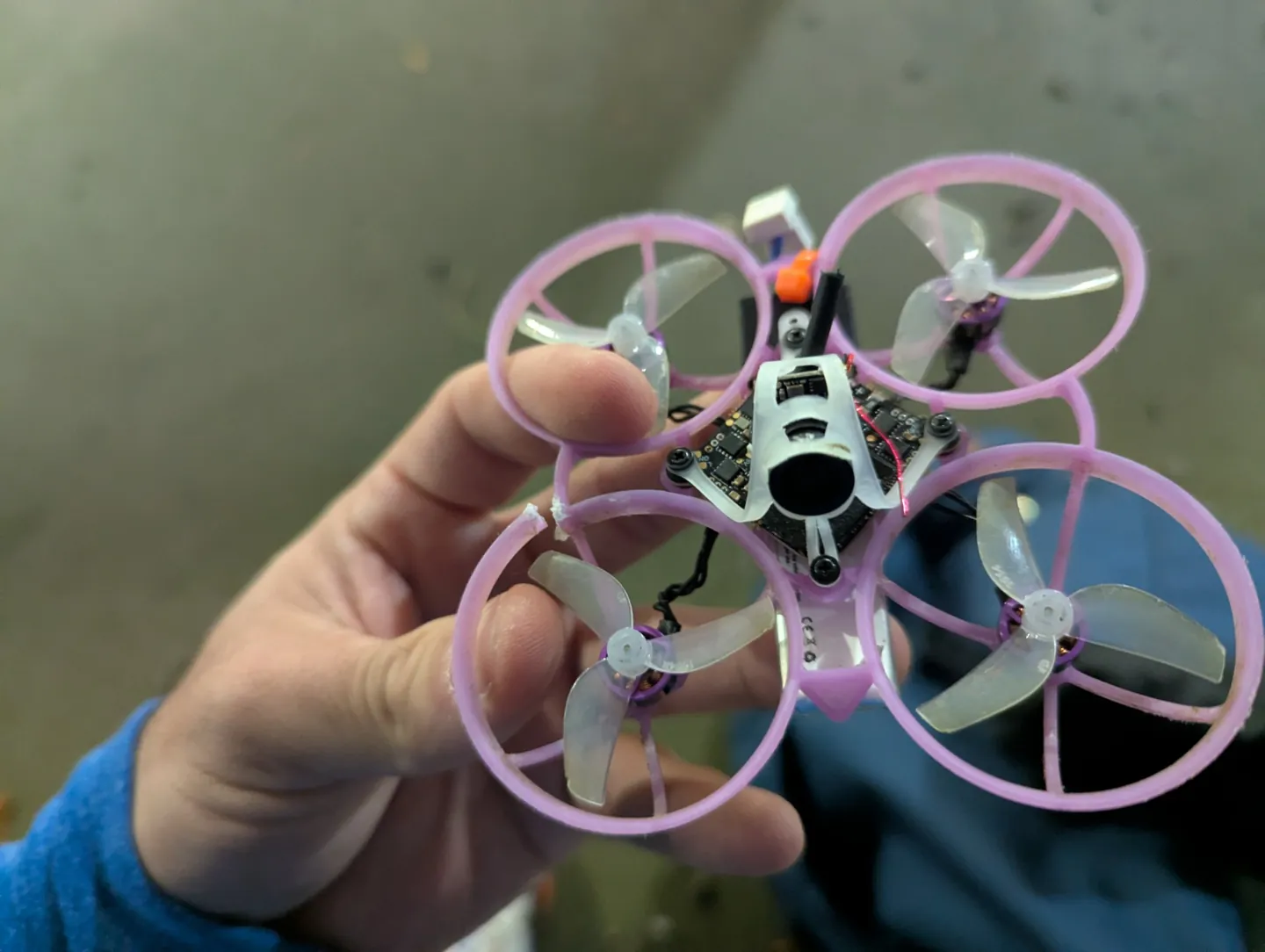
It did not go as expected. I gave it what felt like a polite amount of throttle. The drone went straight to the ceiling, hit it, and came back down hard. Total flight time: about one second. Total confidence remaining: noticeably less.
A simulator is a clean room. Every drone in it is set up perfectly, the video never breaks up, and gravity has read the manual. A real drone has a throttle that reacts to every twitch of your thumb, video that fades behind a wall, and firmware settings nobody told you about. In the simulator, I was a pilot. In my living room, I was a person holding a radio near a small angry bee.
The simulator did its job. My thumbs knew what to do. Everything else had to catch up.
That "everything else" turned into compiling firmware, flashing three versions of the same board, fixing backwards throttles, fighting my neighbors' Wi-Fi, and crashing a lot. A lot a lot.
But that's a story for Episode 1: I Flashed It, I Crashed It, I Rebuild It.
The footage, including the ceiling, is headed to the Gorilla Whoop Whoop YouTube channel.